
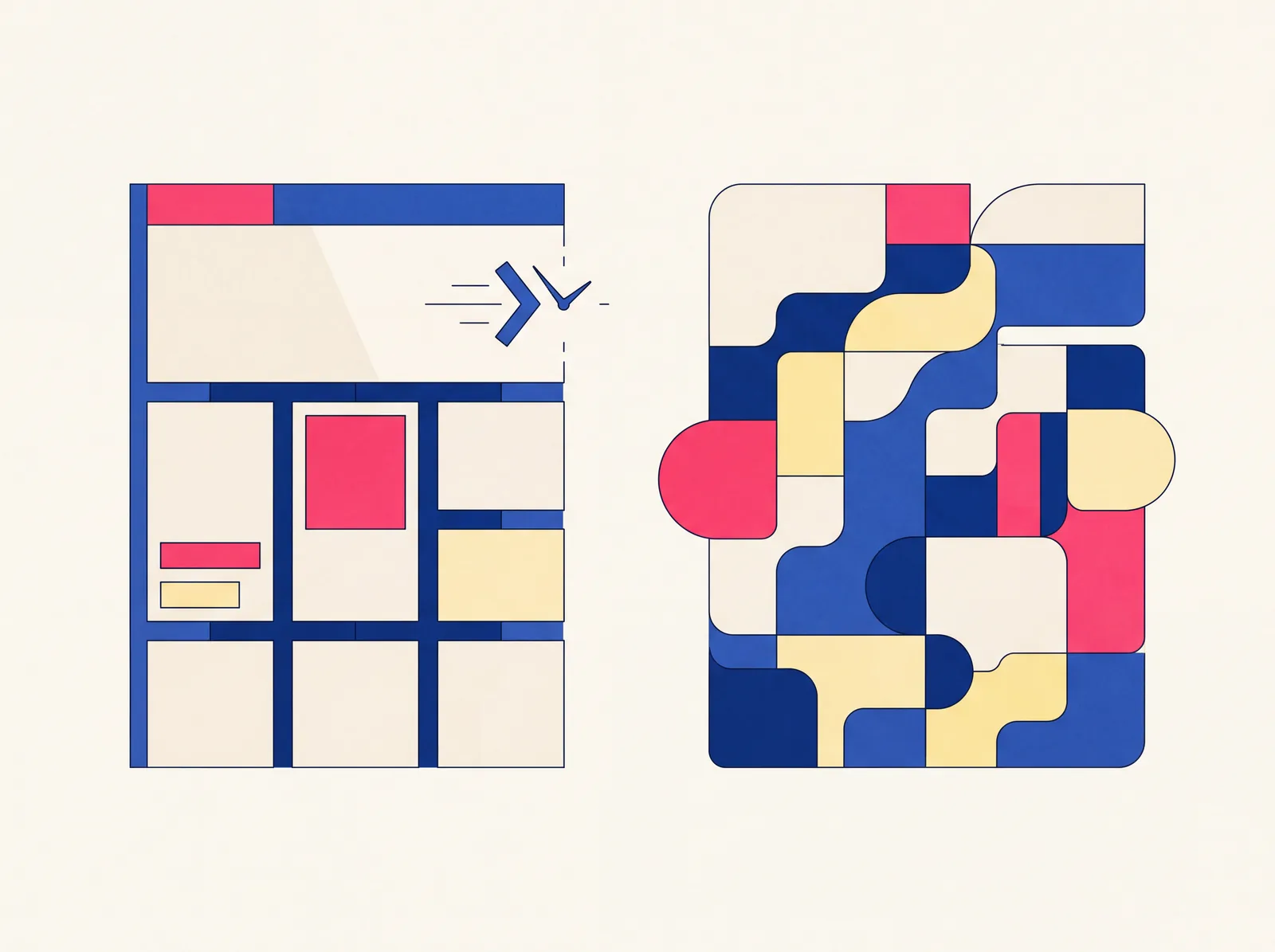
A template website is faster and cheaper because the design decisions are already made for you — you're filling in a structure someone else built. A custom website costs more because someone is designing that structure specifically around your business, your content, and what you actually need it to do. Neither is objectively better; the right choice depends on your budget, your timeline, and whether your business fits neatly into what a template assumes about it.
What you're actually comparing
It helps to be precise about what "template" and "custom" mean, because the terms get used loosely.
A template site starts from a pre-built layout — sections, spacing, and structure already decided — and you customize colors, swap in your logo, and drop in your content. The building blocks exist before your business does. This is fast because the hardest part of web design (structural and layout decisions) is already solved.
A custom site is designed around your specific content and goals from the start. Nobody's deciding "this business will have a three-column feature grid" before knowing what the business actually needs to communicate. It takes longer because those decisions are being made fresh, but the result fits your actual business instead of an assumption about what an average business in your category looks like.
Where templates are genuinely the right call
Templates make sense when your budget is tight and getting something live matters more than getting something distinctive. They work well when your business fits a common, well-understood pattern — a restaurant, a salon, a consultant — where the standard sections (menu, gallery, booking, about) map cleanly onto what a template already assumes. They're also the right call when you need something live fast, since there's no design phase to wait through.
The tradeoff is real, though: you're constrained to what the template allows, and if your business doesn't fit its assumptions cleanly, you'll spend time fighting the template instead of benefiting from its speed.
Where custom is worth the extra cost
Custom design earns its price when your business doesn't fit a standard mold — when what you offer, how you explain it, or how a customer needs to interact with your site doesn't map onto an existing template's structure. It's also worth it when the site needs to do something functional beyond display — a booking flow with real logic, a calculator, a dashboard — because that functionality usually can't be bolted onto a template without fighting its constraints.
Custom is also the right call when differentiation actually matters to your business — when competitors in your space largely look the same, and standing out visually is part of how you compete for attention.
The comparison that actually matters: total cost, not just build cost
The upfront price difference between template and custom is the number most people compare, but it's not the full picture. A template can develop hidden costs over time: fighting its constraints to add something it wasn't built for, redesigning later because it never quite fit, or looking generic in a market where a competitor's custom site visibly outshines yours. A custom build has a higher upfront cost but nothing to fight against later, because it was built around your actual requirements from day one.
Neither direction is automatically the smarter long-term bet — it depends on how much your needs are likely to grow past what the template covers, and how much that growth is worth to you now versus later.
How to decide for your business
Ask three questions. Does a standard template layout actually fit what I need to communicate, or am I already imagining workarounds? Does my site need to do anything beyond display content — booking, calculation, a dashboard? And how much does visual distinctiveness matter in how my customers choose between me and competitors?
If most answers point toward "this is a standard business with standard needs," a template is a legitimate, sensible choice — not a compromise. If you're already running into "but I also need it to..." while picturing a template, that's usually the signal that custom is worth the extra cost.
You can see what custom, purpose-built work actually looks like on our portfolio page, and if you're not sure which side of this your business falls on, get in touch — we'll give you a straight answer, including if a template is genuinely the better call for you.
FAQ
- Can I start with a template and move to custom later?
- Yes, and it's a common path — start lean, prove the business works, then invest in a custom build once you know exactly what it needs to do. The tradeoff is that content and structure decisions made for the template usually don't transfer directly, so it's closer to a second build than an upgrade.
- Are template sites bad for SEO compared to custom sites?
- Not inherently — a well-built template can perform fine in search. Page speed, mobile usability, and content quality matter more for SEO than whether the underlying design is template or custom.
- How much more does custom actually cost than a template?
- It varies widely depending on scope, but the honest driver of cost either way is what the site needs to include and do — see our full cost breakdown for what actually moves the number.
- Is a custom website always more distinctive than a template one?
- Only if it's designed with that intent. A rushed custom build can end up looking just as generic as a template — the value of custom comes from deliberate design decisions, not from the label itself.